Here’s my review, soon to be published in print and online – I’ll provide a link when it’s available. UPDATE: Link to review in Folio Weekly.
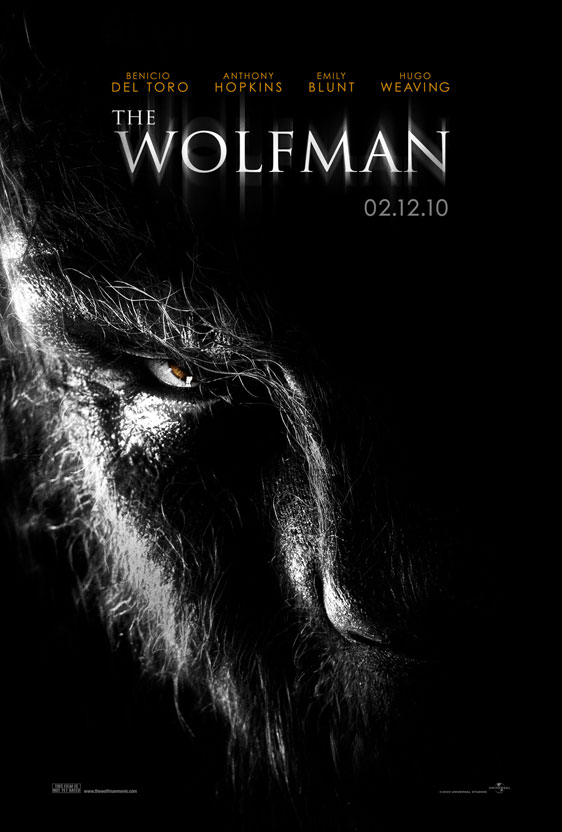 The Wolfman – 125 minutes; rated R
Are monster movies supposed to be genuinely frightening or merely horrible, in terms of the intensity of the shots featuring the beastly killers, sequences often calling to attention the CGI feats and make-up wizardry making it all possible? Is the sheer amount of bloody human carnage meant to strike fear in the hearts of moviegoers, or is it just intended to leave filmgoers awed and maybe a bit sickened by the technical achievements?
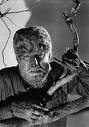
Those are the questions I kept returning to while watching The Wolfman, Joe Johnston‘s unscary if occasionally freaky big-budget creature feature, which was plagued with release delays and production snags, including a switch in directors. It’s inspired by, but hardly beholden to, 1941’s “The Wolf Man,” the Universal horror classic starring Lon Chaney Jr.
The hype about the film’s gore is to be believed. The movie practically oozes with blood, as the titular hairy creature, played by the already hirsute Benicio Del Toro, makes his way across the woods, villages and cities of Victorian England, handily ripping limbs from torsos, separating heads from shoulders, yanking innards from bodies, and chomping and slashing at will. It’s ultra-violence nearly on the order of a George A. Romero zombie movie, or, more to the point, an entry in the Saw series.
While a PG-13 rating may have opened the door to a larger audience, the studio likely went for the R in order to allow the kind of graphic violence apparently demanded by fans of contemporary horror, including the strain known as torture porn.
If intended as an homage, The Wolfman starts out on the right paw, opening with a memorable line from the Chaney movie: “Even a man who is pure in heart and says his prayers by night may become a wolf when the wolfbane blooms, and the autumn moon is bright.” Blood-red titles announce the setting – Blackmoor, England, 1891, several decades earlier than the time frame of the black-and-white original. A man walks through a creepy forest, peering around in fear, as something unseen rustles around in the woods. Yes, he’s doomed.
Too bad that chilly supernatural vibe is not maintained by Johnston, responsible for dino thriller Jurassic Park III and children’s fantasy Jumanji, and screenwriters Andrew Kevin Walker (Sleepy Hollow, Se7en) and David Self (Road to Perdition, The Haunting). Instead, this incarnation of the beast’s story is half slasher flick, half psychological thriller, with twists that are altogether more puzzling than satisfying. There are points at which viewers are jolted, but those scares largely result from false alarms and lightning-speed whooshes by the beast, rather than anything that might cause post-screening shivers.
Del Toro is Lawrence Talbot, born to the British aristocracy, now a successful New York actor, returned to the family estate in order to investigate the mysterious death of his younger brother. Summoned to the rural mansion by Gwen (Emily Blunt), the beautiful woman to whom his brother was engaged, Larry runs headlong into his loopy dad, Sir John (Anthony Hopkins), a burnt-around-the-edges sort who worships the moon and is given to making odd pronouncements. Hopkins’ performance is decidedly messy, as if he weren’t quite sure whether to play it straight or rush right over the top, while Del Toro broods, mumbles and whispers too much to make Talbot a truly sympathetic character.
“Never look back,” Sir John tells his sole surviving child. “The past is a wilderness of horrors.” Here’s where Johnston diverges from the original, as the curse of lycanthropy extends farther back into Talbot’s past than he previously had imagined. So in addition to the usual encounters with surly, superstitious pub dwellers and villagers, including a man of the cloth who declares one man “cursed,” and an old gypsy crone played by Geraldine Chaplin, Talbot deals with a persistent Scotland Yard inspector (Hugo Weaving), the horrors of an insane asylum, and some crippling repressed memories.
Science, it seems, isn’t sufficient to deal with the “unnatural” world, an idea that resonates strongly in the film’s most inventive scene — a group of scientists gather during a full moon to mock Talbot, who’s tethered to a chair and, presumed to be suffering from delusions, warns that he will kill them all.
Man-to-wolf makeovers, creature-versus-creature showdowns and fiery explosions make reliable crowd pleasers, and Johnston doesn’t disappoint on those counts: The movie includes several impressive transformation sequences — abetted by veteran horror make-up effects artist Rick Baker — and concludes with a wolfman-on-wolfman fight and the destruction of Talbot Manor.
It’s hard to keep the wolfman down, as demonstrated by the numerous movies in the genre, including An American Werewolf in London, a horror comedy that was the most entertaining of the spate of lycanthropy-oriented movies of the early ’80s. The hairy beast also popped up in the Underworld and Twilight films.
For wolfman fans not sated by the latest retelling, there’s hope: A secondary character in The Wolfman shows signs of turning wolf, suggesting a potential sequel. And reportedly more than a dozen werewolf movies are on the way.