Florida-obsessed serial killer Serge and his addled pal Coleman are back to help the innocent and punish wrongdoers — or just those guilty of violating Serge’s unique code of behavioral ethics — in “Gator a-go-go,” the 12th piece of comic crime fiction from Tim Dorsey.
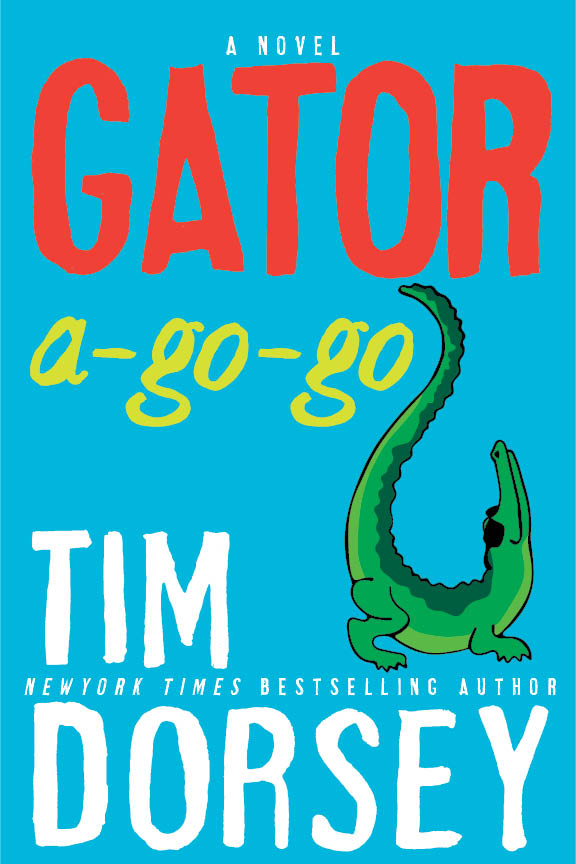 The Tampa author is an old Tampa Tribune colleague of mine. I reviewed his latest novel for the Sarasota Herald-Tribune. Click here to go to the story at the Herald-Trib site, or read the full text below.
Tim is making appearances all over Florida — including this Thursday at Inkwood Books and Friday at Skipper’s Smokehouse — to kick off his national book tour. For all the details, click here.
——–
Gator a-go-go
By Tim Dorsey
William Morrow, 352 pages ($24.99)
Breeze through enough of Tim Dorsey’s wacky serial-killer novels, and, if you have even a little Florida sand in your shoes, sooner or later you’re likely to come across a favorite locale. And you might even pick up a long-forgotten historical fact along with the funny if pointedly farfetched crime fiction, which the Tampa author has cranked out at the rate of about one novel a year since his debut, “Florida Roadkill,” was published in 1999.
Southwest Florida gets a nod or two in “Gator a-go-go,” 12th in the series of books following the misadventures of Serge A. Storms, a coldblooded murderer with a soft spot for all things Sunshine State. Early on, there’s a bit of nasty action in and around a Boston Red Sox spring training game in Fort Myers. Late in the fast-moving story, film noir-loving detective Mahoney, a recurring character in the series, shows up in Anna Maria, the laidback, beautiful island community where Dorsey is known to hole up on occasion.
There, Mahoney, dressed in a worn fedora and tweed coat, visits the ramshackle Rod and Reel Pier, with its tiny, homey bar on the first level topped by a restaurant boasting great views of the Sunshine Skyway, accompanied by rather ordinary food and service. And Dorsey throws in a factoid for free: “…from the tiny pier, just a few swimming yards from shore, on June 28, 1975, a then-record 1,386-pound hammerhead shark was landed. The jaws used to hang on a plaque in the bar, but now they’re at a museum up the street.”
The brief Anna Maria sequence is just a detour in the plot, mostly set in the state’s spring break destinations — recent hot spot Panama Beach, Daytona Beach, and Fort Lauderdale, where northern college kids began coming by the hundreds of thousands after the release of 1960 beach-party comedy Where the Boys Are.
Trim but tough teetotaller Serge and his oversized booze- and pot-addled pal Coleman are travelling to all three tourist towns in order to make a documentary on spring break. The former is handling the feature-film footage, while the latter is assigned to the behind-the-scenes material destined for the eventual DVD release.
Along the way, they pick up a pair of sexy, fast-living old friends named City and Country, and use ingenious fatal contraptions to punish various folks unfortunate enough to bump against one or more of Serge’s pet peeves — drivers who fail to yield to emergency vehicles, lowlifes who prey on innocent tourists, and “Girls Gone Wild” types who take advantage of drunken college students.
It’s not just the usual comic mayhem this time, though. In addition to hanging out with an admiring posse of college kids, some enamoured with Coleman’s 1001 ways to more efficiently get trashed, Serge wanders into a sticky conflict: a 19-year-old boy in a witness protection is endangered by a sort-of Latinized version of Ma Barker’s gang, and a mole in law enforcement is sabotaging efforts to keep the kid safe.
As per usual in Dorsey’s books, the action is spiked with snippets of Florida history — pop culture and otherwise. It’s difficult to resist a crime story that makes references to Tom Petty, Ken Kesey, Elvis and the Creature from the Black Lagoon, too. Did I mention the quartet of nonagenarian granny bikers?
—–
Other reviews of “Gator a-go-go”
 Not long after Tim Dorsey’s first book, Florida Roadkill, was published in 1999, I interviewed the Tampa writer for a piece published in The Orlando Weekly (as soon as I can track that down, I’ll link to it here).
 Tim talks about Nuclear Jellyfish, his recently published 11th book in a decade, in a story written by UF journalism prof William McKeen and published in this week’s Creative Loafing.
 Now this: The final edition of the Rocky Mountain News, a 150-year-old (!) daily newspaper, will be published this Friday.