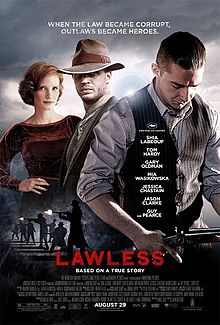
Stars Shia LaBeouf, Tom Hardy, Joseph Clarke, Guy Pearce, Jessica Chastain, Mia Wasikowska, Dane DeHaan, and Gary Oldman. Directed by John Hillcoat, from a script by Nick Cave, based on Matt Bondurant’s novel “The Wettest County in the World.” Rated R. 115 minutes. Critic’s grade: A-
“Lawless,” several cuts above the usual Hollywood moonshine-and-shotguns saga, benefits from being streaked with appealing shades of artfully rendered Americana. It’s there in the images of rural Virginia mountainsides, orange fires from myriad illicit whiskey stills popping through the nighttime mist, all beautifully captured by cinematographer Benoit Delhomme. His cameras also rest on lush sun-soaked greenery, along with the picturesque covered bridges and often ramshackle wooden structures that dot the landscape.
That Americana can be felt, too, in the laconic drawl and hushed mutters marking the speech of Forrest Bondurant (Tom Hardy), ringleader of a family-run moonshine operation; he’d just as soon baffle an enemy with backwoods-philosophy BS as he would take the guy out with the help of a swift right punch and brass knuckles. And it’s there in the rootsy bluegrass, country, and gospel music — the likes of Ralph Stanley, Willie Nelson, and Emmylou Harris — heard on the score, assembled and assisted by veteran Australian singer and songwriter Nick Cave.
Cave also wrote the screenplay, based on a book, “The Wettest County in the World,” written by a descendant of the Bondurant brothers. Australian-born Director John Hillcoat (“The Proposition,” also penned by Cave, and “The Road”), working with such rich material, has turned out a thriller that’s often grotesquely violent while never quite adequately exploring the dynamics holding together the rough-hewn siblings. Aside from greed and revenge, what makes the alternately taciturn and eloquent Forrest, the imbalanced, often drunk and enraged Howard (Jason Clarke) and excitable young Jack (Shia LaBeouf), called “the runt of the litter,” remain so loyal to one another?
Following a brief prologue, during which Jack proves unwilling to shoot a pig on the family farm near Franklin, Va., the story shifts to the early ’30s. Prohibition is in effect, and the Bondurants are riding high on the new family business, making hooch and selling to the locals, including whites at a bluegrass stomp, blacks at a raucous wake, and local police who get a special deal for turning a blind eye to the illegal goings-on.
That comfortable system is disrupted by Chicago gangsters wanting a piece of the profitable illicit-booze economy. One such interloper, Floyd Banner (Gary Oldman), makes his entrance wearing a pinstriped suit and black hat, lit cigar clenched between his teeth, shooting a Tommy gun into the car of an enemy. Banner is tough but reasonable, eventually amenable to a partnership with Jack; Oldman fires on all cylinders with a role that appears to have been trimmed back).
Special Deputy Charlie Rakes, brought in by the local district attorney, is anything but open to compromise. The foreign-accented Rakes, cunningly brought to life by another Australian, Guy Pearce (“The King’s Speech,” “The Proposition,” “Memento”), is a federal lawman whose corruption is exceeded only by his viciousness and his penchant for carrying out even the most brutal beatings while dressed to the nines, his jet black, slicked back hair not mussed in the slightest. After one such encounter, he carefully peels off his blood-stained leather gloves, viewing them with distaste but experiencing no remorse for his horrific attack. Rakes’ sexual interests come off as purely predatory and largely undiscriminating — he has a taste for prostitutes and the weak — and he revels in his position of power. The Rakes-ordered tarring and feathering of one character, and the aftermath, are particularly gruesome. Rakes is so fearsome, even to the point of outlandishness, that he sometimes appears to have walked onto the set from another movie.
Rakes is hardly the only character to use extreme violence in order to get what he wants. In the Bondurants’ world, that approach is sometimes, if regrettably, necessary, as Forrest explains to Jack. “It is not the violence that sets a man apart. It is the the distance that he is prepared to go.”
The film’s not all boys, booze, and guns. Along the way, Jack courts Bertha (Mia Wasikowska), the pretty daughter of a local religious leader; a feet-washing ritual during the church’s Sunday meeting, complete with a cappella singing and rhythms created by foot-stomped floorboards, makes for one of the film’s most intense moments, which then spills over into comic relief. Forrest, too, feels a growing attraction for the statuesque Maggie (Jessica Chastain), a troubled woman who fled from her life as a girlie dancer in the big city.
In addition to first-rate work from Pearce, Oldman, Chastain and Wasikowska, “Lawless” thrives on intriguing turns by Hardy (“The Warrior,” “Inception”) and Clarke (“Trust,” “Public Enemies”) and a career-best performance for LeBeouf (the “Transformers” trilogy, “Indiana Jones and the Kingdom of the Crystal Skull”).
And there will be blood, lots of it, during a final showdown that seals the fate of several major characters. The climactic shoot-out is to be expected, but the consequences aren’t necessarily predictable. Nor is the prologue, which seems to suggest that even good things happen to bad people, a message that might even count as subversive. “Lawless,” while not a classic of its genre, often comes darn close.