(also reviewed for Creative Loafing/Tampa; click here to read)
Stars Bill Murray, Laura Linney, Olivia Williams, Elizabeth Marvel, Samuel West, Olivia Colman. Directed by Roger Michell from a script by Richard Nelson. 94 minutes. Critic’s grade: C+
It’s been something of a banner movie year for American presidents: Summer brought a leader of the free world with a secret passion and admirable expertise for offing the undead. The fall gave us Spielberg’s real Lincoln, as opposed to the vampire slayer, this time magnificently portrayed by Daniel Day-Lewis, who humanized the man while properly deifying him as a slave emancipator and nation healer. Jimmy Carter was seen and heard in Ben Affleck’s taut comic political thriller “Argo.” Obama is a background presence in the controversial, acclaimed killing-Osama actioner “Zero Dark Thirty.”
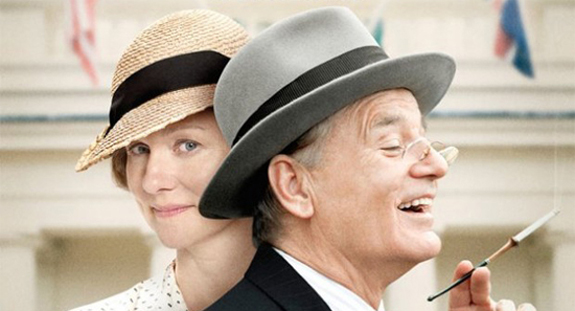
And now for something completely different, a first in the history of US presidents on film: “Hyde Park on Hudson” has Bill Murray as a frisky Franklin Delano Roosevelt, taking a long ride through the lush hills of upstate New York with pretty, proper distant cousin Daisy (Laura Linney). They cap the trip with a round of discreetly photographed erotic pleasure, as Glenn Miller’s “Moonlight Serenade” plays softly on the convertible’s radio.
FDR’s cheatin’ heart, leading him to share his affections with multiple women, including wife Eleanor (Olivia Williams) and private secretary Missy (Elizabeth Marvel), unfortunately is a theme writ overly large in a film that otherwise makes for a perfectly pleasant comic diversion.
Murray, to his credit, sensibly doesn’t go the route of full-on impersonation. He neither looks nor sounds like FDR, in real life a handsome, broad-shouldered man with a well-defined patrician accent. But peering through those pince-nez glasses, and using the iconic long-stemmed cigarette holder, Murray does manage to convey the easy smile and well-practiced charm associated with Roosevelt. And there’s little to none of the sly jokester sensibility that’s frequently at the heart of many winning Murray performances, including in this year’s “Moonrise Kingdom.”
“Hyde Park,” directed by Roger Michell (“Venus,” “Notting Hill”) concerns a narrow slice of history that hasn’t been given much attention. It’s 1939, the Great Depression is lingering, and the whole world is watching to see what the ascendant Hitler will do next. King George Vl, known as Bertie (Samuel West), the same stutter-afflicted man who was the focus of “The King’s Speech, brings Queen Elizabeth (Olivia Colman) along on a trip to FDR’s summer home, a rambling place ruled with an iron first by FDR’s mother Sara (Elizabeth Wilson). The King is on a mission to elicit America’s support of its former nemesis, in the likelihood that England will go to war with Germany. “Without some help from us, there may soon not be an England to be king of,” FDR declares at one point.
Michell’s film, from a script by Tony-winning playwright Richard Nelson, stumbles largely because it seems so unsure of its identity. Is it primarily the story of the heart-crushing education of the previously sheltered Daisy, heard in voiceover several times throughout the film? Linney gives a somewhat drowsy performance as a woman who travels from awed respect of FDR to quiet intimacy, as his closest confidante, to enormous disappointment.
Or perhaps the movie is meant to be a tale of two cultures clashing. Several of the film’s funniest sequences juxtapose the royal couple’s stolid propriety with the American president’s far more casual and laidback approach to daily living. The king and queen are put up in a room where one wall is adorned with a series of cartoon drawings mocking the Brits’ efforts in the War of 1812, and the couple is told that they should look forward to an afternoon picnic, in their honor, where hot dogs will be served. “Are they trying to make fun of us?” Elizabeth asks.
The film’s finest, most convincing dramatic moments come during a sequence during which FDR and Bertie drink, smoke, and talk casually, exchanging confidentialities regarding their respective indignities — the former’s polio, which has made his legs useless, and the latter’s stutter, particularly pronounced during times of great stress. Too bad that that relationship, even if greatly expanded for dramatic effect, had not shifted to the center of the film. As it is, the movie weaves and wobbles, closing with a postscript suggesting that Daisy was afflicted with a case of endless love after all, a notion that’s as sweet as the film is slight.